bing pixel

߲Ƶ

Chautauqua Lecture

Najeeba Syeed speaks ‘from the broken heart of democracy’ on interfaith peace


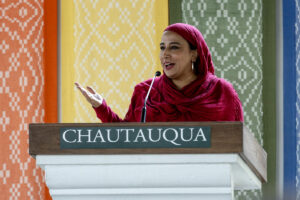
Professor Najeeba Syeed participated in the Chautauqua Institution’s Interfaith Lecture Series: Faith in the Public Square.


“Democracy is not a religious act; it is a spiritual struggle.”

Professor Syeed structured her lecture on the teachings of Christian ethicist Glen Stassen and U.S. religion sociologist Robert Bellah.

Read about her lecture in the

In Defense of Awkward Spaces

Prof. Najeeba Syeed has written a  “In Defense of Awkward Spaces”:

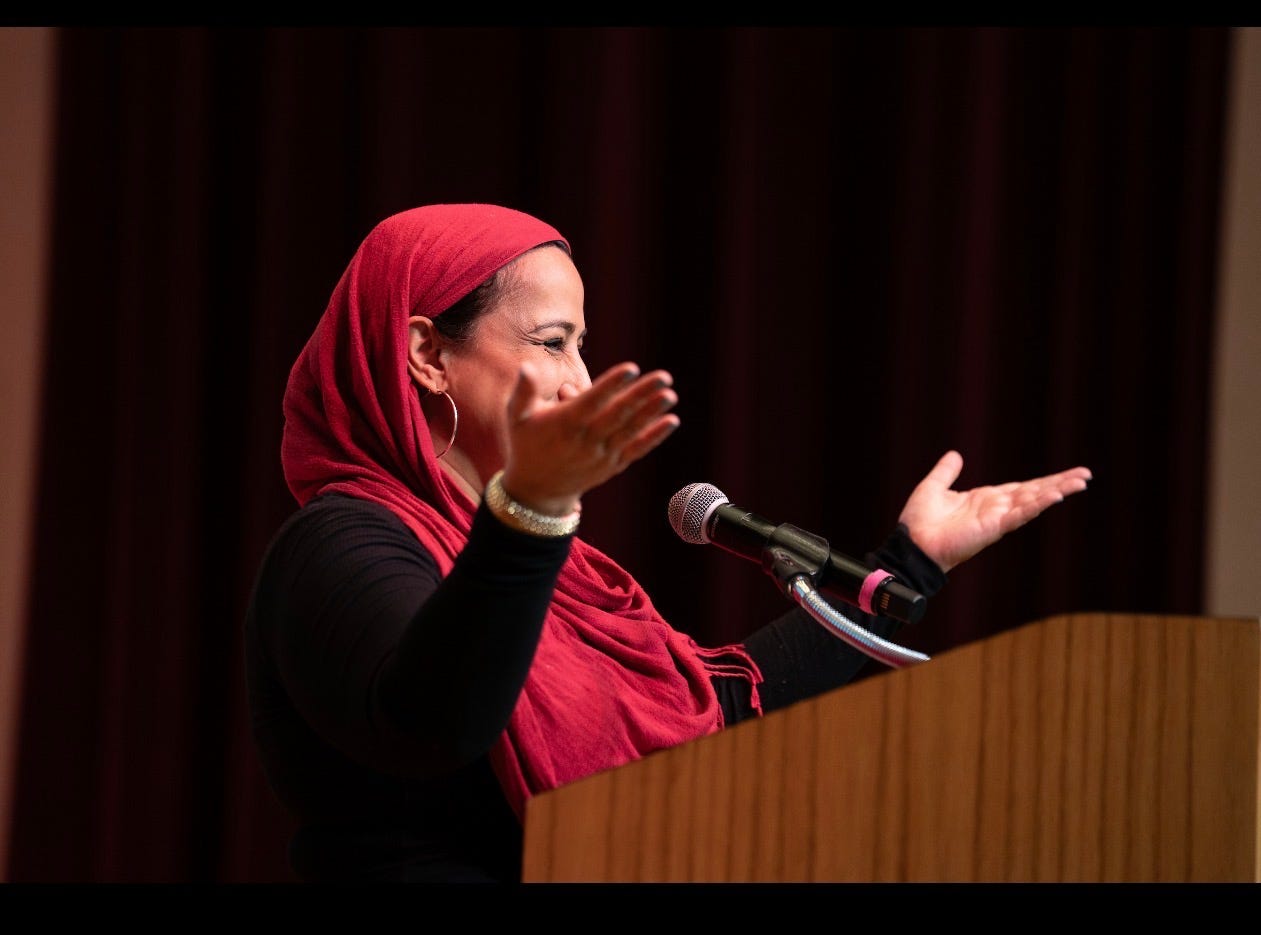
Najeeba Syeed, wearing a red hijab and hoop earrings, smiles at a microphone and gestures to the audience

I am back home after another set of travels, a summer of teaching and learning and growing in the work of Peacebuilding.
I’ve written before about safe spaces and brave spaces and now I am writing in defense of awkward spaces.

The spark that ignites understanding, before the magic of humanizing one for another comes through the space that feels hard, feels unnavigable, it pulls on our imagination.

I spent much of my summer as a steward of awkward space. Teaching mediators, leaders, students, university administrators, community organizers and others to *hold* that space.

The flourishing silences, the unpredictable exchanges, the fumbling moments, the times when we pray our tongue is untied for others to understand us (that is a prayer of Musa (Moses) that I shared this summer with others from the Muslim tradition.

Leadership needs us to to be vulnerable and awkward. Maybe we need to hold our selves as examples of works in progress not just paragons of perfection, and to hold others when they fall apart, maybe just a little maybe sometimes a lot.

I am here for your awkwardness I embrace it and you. I hope you will do the same for me.

Together I believe it’s the only way we will all flourish.

It can be helpful to model awkwardness as a facilitator. I know this is counter intuitive when you want to seem the expert, I’ve learned people respond much more to authenticity. Share a story of what didn’t work in the past, be honest about a time you were nervous about a conversation.

Facilitators who’ve had to navigate awkwardness together and came out of the tunnel as closer colleagues and friends are often a great team to lead these kinds of spaces.

And remember every space is awkward for someone in the room.

Maybe it’s time we all embrace, and even celebrate those awkward moments.


Podcast Interview

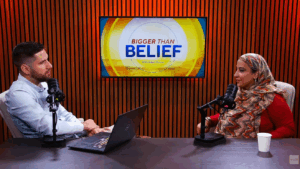
Adam Duxter and Najeeba Syeed smile, facing each other at a table with microphonesProf. Najeeba Syeed was interviewed on the podcast Bigger Than Belief with Adam Duxter, produced by , the local Minnesota CBS affiliate television station. The episode covers a range of topics: “Facing a Cancer Diagnosis: Najeeba Syeed on Faith Across Differences & Finding Peace in Uncertainty.”
As WCCO writes, Prof. Najeeba Syeed “challenges the idea that religious differences must divide us. Instead, she argues that authentic faith should expand our capacity to love our neighbors, engage conflict with courage, and build meaningful relationships with people who see the world differently. The conversation takes an unexpected and deeply personal turn when Najeeba reveals she is awaiting results from a biopsy and facing the possibility of a cancer diagnosis. In that vulnerable moment, she reflects on prayer, uncertainty, and the surprising people who have shown up for her—including friends and colleagues from different faith traditions. Her story becomes a powerful reminder that our deepest connections often emerge not from shared beliefs, but from shared humanity.”

Timestamps

  • What Faith Does With Life’s Curveballs
  • Meet Najeeba Syeed: Peacebuilder, Professor & Interfaith Leader
  • From Kashmir to Indiana: Growing Up Muslim in the Heartland
  • How to Stay Rooted in Your Faith While Building Bridges Across Religions
  • “I’m Awaiting a Cancer Diagnosis” — Who Shows Up in a Crisis of Faith?
  • Finding Common Humanity in a Divided World

Inspired Generosity Minnesota

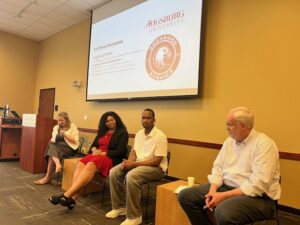
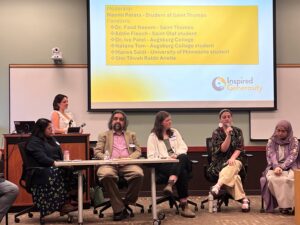
a national showcase of powerful stories of generosity from the Muslim American community, was featured at in Minneapolis March – May. Augsburg students presented at several showcase related events, including the opening reception panel on religious traditions of generosity, and a panel on Earth Day. In April, Augsburg staff and student presented to a group of local DEI leaders on Augsburg’s response to Operation Metro Surge.

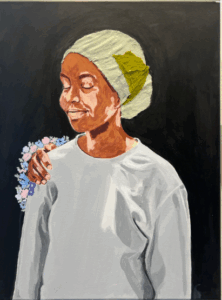
In addition to student panelists at IG MN events, Augsburg graduates Ayan Mohamed ’25 and Rahma Mohamed ’26 contributed a self-portrait painting and a video poem to the showcase. View Rahma’s poem 

Ayan notes, “In this self portrait, flowers are emerging out of my mothers hand as I face away from the audience. These flowers stand out as a contrast to the darker background and gray sweatshirt as an embodiment of light in my life. This symbolizes my mother’s generous support and love as I struggle with wearing my hijab.”

Pieces of Ayan’s hijab in the painting further represent her view of Muslim American generosity.

Sahan Journal Spotlight

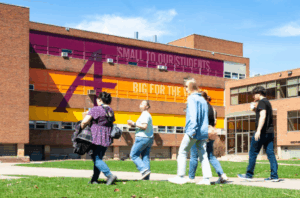
Students cross the quad at ߲Ƶ in the Cedar-Riverside neighborhood of Minneapolis
Students walk across campus
Credit: Aaron Nesheim | Sahan Journal

Interfaith Institute Executive Director Najeeba Syeed was featured in an Augsburg spotlight in the Sahan Journal.

Founded in August of 2019, the Sahan Journal is a nonprofit digital newsroom dedicated to reporting for immigrants and communities of color in Minnesota. Education reporter Becky Z. Dernbach provided a window into community care on campus: “Caught in the crosshairs: How ߲Ƶ mobilized to protect students during the ICE surge.”

Read more in the


Interfaith Symposium 2026

Healing the Earth, Healing Ourselves – Tending to the Soil We Share

By: Jerilyn Miller, Sr. Benefactor Relations Specialist

There was a moment during the Interfaith Symposium—Healing the Earth, Healing Ourselves—when the room grew still.

Rev. Jen Bailey is speaking and wearing bright yellowRev. Jen Bailey, the keynote speaker, began with a story. She spoke about her grandmother, who worked the sugarcane fields of the American South in the 1930s and 40s, in the shadow of Jim Crow. Despite the violence and inequity around her, she cultivated dignity, community, and life from the land.

In that story was something deeper—the connection between soil and survival, between land and liberation.

Bailey named what many are already feeling. We are living, she said, in a time of “toxic soil.” Not only environmentally, but relationally and spiritually. The fractures we see—climate crisis, political division, loneliness, mistrust—are not isolated problems. They point to a deeper disconnection: from one another, from the earth, and from our shared humanity.

“This is not just a political crisis,” she said. “It is a relational crisis… a spiritual crisis.”

And yet, she did not leave the room in despair.

Instead, she offered another image: sunflowers.

Drawing on the concept of phytoremediation—plants that draw toxins out of the soil—Bailey described the slow, patient work of healing. Even damaged soil can be restored. Not quickly. Not easily. But through sustained care.

Healing, in this vision, is not a grand solution. It is a practice.

With native flower seed packets in hand, participants turned to one another—sharing ideas, hopes, and the ways they are already tending their communities. For Augsburg senior Zuko Buechler ‘26 an urban studies major, the conversation felt both personal and practical.

“I’m learning a lot about practices with the land and healing,” Buechler said. “It’s making me think about how I can plant these seeds at my grandmother’s [home] and share in her love of gardening —a connection that has shaped me.”

Bailey closed with a simple invitation: a daily discipline of choosing to plant something life-giving, even when there is no guarantee of what will grow.

Over lunch, the conversation continued—grounded in honesty about life experiences and resilience. Bex Klafter of Lutheran Social Services reflected on what stayed with her most:

“All land is good,” she said. “There is value—even when the soil needs to be amended.”

It is a simple idea, but one that shifts the frame. Healing does not begin with perfection. It begins with what is already here.

At Augsburg, that kind of work takes shape in real time—in conversations like these, in shared practices, and in a community willing to stay with what is difficult and choosing to tend to what is possible.

Marty Center

We’re delighted that ߲Ƶ President Paul Pribbenow utilized our Executive Director, Prof. Najeeba Syeed’s writing on a lived theology of neighborliness in his recent piece for the Martin Marty Center at University of Chicago Divinity School.

If there is a blessing to be wrestled from the wreckage of Operation Metro Surge, it’s that our students have received an indelible education in what my colleague Najeeba Syeed a “lived theology of neighborliness,” one that is likely to shape their lives forever.

Read his full piece here:

Interfaith Cooperation in Minnesota

March 5, 2026 — Our Executive Director, Prof. Najeeba Syeed offered testimony on interfaith cooperation in the state of Minnesota in response to current crises. She addressed members of the ELCA Lutheran community along with Augsburg Univerisity alumna Kristen Opalinski. Kristen and Najeeba offered theological and practical ways to improve the conditions of communities in this moment. These contributions were grounded in ELCA and multifaith sources and practices. We love collaborating with Lutheran and interfaith partners, especially when they are Auggie alumni!


Zoom call with Najeeba & Kristen

Article: ICE Raids Reignite Rituals of Resistance in Minneapolis

Najeeba Syeed has been featured in an Interfaith America by Rachel Crowe, “ICE Raids Reignite Rituals of Resistance in Minneapolis”:

While ICE’s presence in Minneapolis has propelled the city onto the national stage in recent weeks, Minnesotans have been “grappling with a changed reality on the ground for more than six weeks,” executive director of Interfaith at ߲Ƶ Najeeba Syeed says. “The reality is people are not okay; it’s not business as usual.”

a protestor holds up a guitar in a march protesting ICE actions in MN

Article: Neighborliness is a lived theology in Minnesota


Interfaith Institute Executive Director Najeeba Syeed recently wrote an on Religion News Service about how Minnesotans are caring for each other after the fatal shooting of Renee Good.


People gather around a makeshift memorial honoring Renee Good, near the site of the shooting in Minneapolis, Thursday, Jan. 8, 2026. (AP Photo/John Locher)