If the temps dip too low, having winter fun in Minnesota can often be a matter of trying to make lemonade out of lemons! Learning how to do that can be tricky. So in the late 70s, Augsburg offered a self-directed interim class, authorized by then-dean Charles Anderson, to beat the winter blues. Entitled “Recreation and Conditioning for Minnesota Winter,” the class included working out in Si Melby, then going outside for winter sports—cross-country and downhill skiing, skating, snowshoeing, and even ice fishing.
At an Augsburg event two years ago, six Auggies in attendance realized that the entire group from that 1978 interim class was present, so they gathered for the picture above. They are, left to right: Donadee (Melby) Peterson ‘78, a big fan of winter activities and currently in Oslo, Norway, where her Auggie husband, Tim Peterson ’76, is serving as an interim pastor; Noreen (Walen) Thompson ‘78, a retired medical device marketing vice president, in front of husband Steve Thompson ’78, a retired US Bank vice president; LuAnn (Hedman) Wingard ‘79 in front of husband Tom Wingard ‘78, who together own a large family-run potato farm operation near Elk River, Minnesota; and Bev (Ranum) Meyer ‘78, a retired actuary in benefits consulting. Bev’s husband, Dennis J. Meyer ’78, also an Auggie grad, is a retired marketing executive who serves on the Board of Regents.
For some, this class has been fondly remembered as a reason to stay in Minnesota and enjoy the winter weather.
Gather your friends and make plans to join us at the first-ever All-School Reunion on September 26, 2020!
Just in time for Valentine’s Day, join the Augsburg Associates for a “Sweetheart of a Sale” on February 11th and 12th from 10 a.m. to 3 p.m. in the Christensen Center. With vintage jewelry, Valentine-themed gifts, and more it will be a great opportunity to pick out unique and special treats for Valentine’s Day! Love is in the air… see you there!
Tori, her husband Paul Sanft ’05 and their daughter Eleanor
Dr. Tori Bahr ’09, a medical doctor at the complex care clinic of Gillette Children’s Hospital in St. Paul, has been awarded º¬Ð߲ÝÊÓƵ’s 2019 First Decade Alumni Award. The presentation will be made at a January 10 event in her honor.
Bahr has always been fascinated by how our bodies work, and she started expressing interest in being a physician as far back as kindergarten when she knew an older student with cancer. Over the years, she was naturally drawn to science classes, and her career plans didn’t veer. When she entered Augsburg to do premed coursework, she settled into a chemistry/biology double major.
However, after her third year as an Auggie, some questions loomed. As she worked on her personal statement for medical school, she realized she didn’t know why she wanted to be a physician.
Mind the gap
Before long, she saw the wisdom in taking a “gap year” to explore those areas that interested her most—teaching and medicine. During this gap, she worked at multiple jobs. As a result of teaching ACT and MCAT prep courses, and tutoring high school and college students in math and science, she learned that not only did she prefer one-on-one teaching over classroom teaching, but that “there are few things better in the world than helping a student struggling to understand a subject to master it and excel.”
During the gap, she also worked as a medical scribe for a company in Shakopee, run by an Auggie, Jaime Kingsley-Loso ‘01. In this setting, she was exposed to multiple patient encounters by Emergency Physicians, which gave her a striking picture of how incredible it is to be able to apply the physiology she had learned in science classes to impact human disease. Already inclined toward compassion and patient-centered care, she was impressed with some physicians there who used their time at a patient’s bedside to educate the patient and family.
And it struck her. She could do both—medicine and teaching.
With her gap-year workload already excessive, Bahr decided, nonetheless, to answer an ad on Craigslist to become a personal care attendant for a young woman (an Auggie) with a neurological condition. It was this experience more than anything else that solidified for Bahr that medicine was the first career she would pursue. Here, she learned how physicians and medicine really impact a person’s everyday life, and she saw the importance of understanding the effects of that which she prescribed and asked of the patient and family.
The gap year had been most instructive in Bahr’s emerging sense of career, and the clarity was further enhanced in the summer prior to her Augsburg graduation, when she spent a month in Ghana, working in a health clinic in a small village.
Transition care and complex diseases
Bahr’s new work at Gillette Children’s Hospital, which began in November, provides a fine opportunity for her to serve in two emerging and underserved areas dear to her heart. The first is seeing patients with medically complex diseases, which often involve technology (such as wheelchairs, feeding tubes, and breathing tubes), neurocognitive delays, and multiple specialists. Integration among specialties isn’t automatic—or even common.
The second area is championing transition care, a relatively new focus that pediatric and adult healthcare systems across the country are struggling to address, now that children born with severe heart defects, cerebral palsy, or other rare congenital conditions are living beyond their childhood and teen years, even into their 40s. Thus, thanks to drastic advances in pediatric care the last couple of decades, many patients require continuing care into adulthood—care which medical schools didn’t expect “adult doctors” to have to study and eventually provide. And more research is needed to understand long-term risks of these diseases, as well as appropriate preventive care.
During her gap year, Bahr caught a glimpse of the problems with this “transition,” and as a result pursued a combined internal medicine and pediatrics residency program, in which she was trained for—and is now board-certified to care for—both adults and children. Working at the intersection of both categories gives her opportunities to be innovative in her approach. Gillette’s first grant from the Minnesota Department of Health will give a nice boost as they kick off this new work.
Woman, wife, mother, and physician
Prior to her work at Gillette, Bahr served her residency at the University of Minnesota Medical Center, in the Internal Medicine-Pediatrics Program, where she took over as Chief Resident in 2018. Her former co-residents there are among her closest friends, confidants, and cheerleaders, and she sees the MedPeds faculty as having been amazing role models and mentors to her, even showing multiple ways to integrate one’s professional life and personal life.
Bahr will be “forever grateful” for her Augsburg coursework—and to her mentors for not putting her “on the conveyor-belt pathway to becoming a physician.” She specifically mentions Mark Strefeler, Joan Kunz, Sandra Olmsted ’69, Dixie Shafer, Jennifer Bankers-Fulbright, Dale Pederson ‘70, and Doug Green—all of whom encouraged her to honor the process (and pace) of exploring alternate career ideas in order to make absolutely certain that medicine was her true vocation.
Her gratitude to Augsburg extends even further since that is where she met an “incredibly talented, kind, and thoughtful spouse”—Paul Sanft ’05. They met through mutual friends in the Auggie sports network. Sanft owns a video and photography company, Ideatap Studios, and finds time to work at the nonprofit Pacer Center, which helps kids with disabilities navigate everyday life and the school system.
Three-year-old daughter Eleanor is curious and loves to explore, which fits nicely into the family fondness for travel and hiking. And they’ve already gotten a nice head start. After Bahr completed her training to become a physician, the family celebrated by taking a six-week road trip through the Canadian Rockies. Be assured that won’t be their last adventure. Their plan is to visit all 59 U.S. national parks.
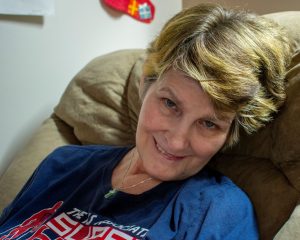
Augsburg alumna Maureen (Conroy) Kurtz ’80 cultivated her l¾±´ڱð’s calling at Augsburg through the intersection of English and theater.
Since graduating in 1980 with her bachelor’s degree studying children’s theatre, Maureen has written, directed, and produced over 80 plays and movies. She also served five years on the Bloomington Art Center Board and was involved with over 50 productions at the Bloomington Art Center, the Capri Theater, the Minnesota Jewish Theatre Company, and various other locations.
But Maureen hasn’t only worked her magic behind the scenes; she’s also spent a lot of time on the stage, going by the name Rina Kurtz. A highlight of her career was in 2014 when she had the opportunity to go to Hollywood and walk on the red carpet for the premiere of Matthew 18, in which she portrayed Miss Hillshire. She also acted in Thunderbird and The Coffee Shop Wars, along with a handful of short films and many plays.
A graduate of Mahtomedi High School, Maureen discovered her love of theater in her youth and worked on and off stage in her high school’s theater productions. When she came to Augsburg in 1975, Maureen had the chance to work with two professors whom she credits as important mentors on her journey to what would become a full life in theater and film: English professor Toni Clark and legendary Theater professor Ailene Cole, who is recognized for her work building Augsburg’s theater department into what it is today and for whom the Green Room in the Foss Center is named.
Ailene Cole played a special role in Maureen’s career at Augsburg by creating a new major that was not only uniquely tailored to Maureen but was also the only one of its kind in the state at that time: Children’s Theater.
“I loved Augsburg because Ailene Cole developed a special major for me in Children’s Theater,” says Maureen. “It was the only school to have a Children’s Theater program.” When asked what made her want to pursue that degree, Maureen said, “I love kids; it was my idea, and Ailene put together independent studies for me.”
Maureen was busy while at Augsburg. She enjoyed Women’s Literature, joined the gymnastics team, served on the English Board for one year, and formed a liturgical dance group. Maureen also studied abroad in London, where she was able to attend 28 plays, 6 of them Shakespeare plays. Her favorite production was Equus, a drama by Peter Shaffer about a psychiatrist who attempts to treat a boy with a pathological religious fascination with horses. It won the Tony Award for best play in 1975.
1977 fall play Two by Two. Maureen is on the far left.
Maureen continued her love of theatrical work on and off stage for Augsburg productions. She directed Talk to Me Like The Rain and Let Me Listen, a Tennessee Williams short play, in 1978. Maureen also acted in the plays Abia Da Capo in 1976, Two by Two in 1977, and The Crucible in 1979. And with a smile, Maureen says she even made her own costumes.
When asked what something people would be surprised to learn about her, Maureen said, “I wrote a couple of puppetry productions.” The productions were called Twink and Charlie Goes to Market. Both were put on at elementary schools. Maureen didn’t plan on doing the puppet production herself, but a last-minute cancellation changed her plans. “I didn’t want to be the puppeteer, but the guy [who was supposed to puppeteer] chickened out! I was nervous!”
Maureen says she is most proud of the 5 years she served on the Bloomington Art Center board, followed by 27 years acting on their stage while working on so many of their productions at the Black Box and Schneider Theaters. And she’s raised two boys in between it all.
This past year, Maureen was diagnosed with ALS. It has greatly limited her mobility and requires her to communicate through text-to-speech computer software using Tobii, an eye-tracking device. She selects characters to form words by looking at them, then the computer speaks the words aloud.
But this has not stifled her creative mind. Earlier this year, Maureen won a “Most Inspirational” award for her poem about ALS in a walk her sister completed in her honor in Missouri. She is also currently producing a movie, Christmas Slasher.
“I have a full life,” Maureen says.
— By Jayne Carlson MFA ‘16 and Amanda Symes MFA ‘15
What Does ALS Stand For?
By Maureen Kurtz, 2019
A.L.S. is:
Acknowledging the L´ǰù»å’s Sacrifice
Always Listening to Silence
Ability to Laugh at Self
Accepting L¾±´ڱð’s Setbacks
Adoring every Little Second
Awestruck by the Light of the Stars
Adhering to the Lessons of the Soul
Appreciating the Luxury of the Sun
Avoiding L³ܳ¦¾±´ڱð°ù’s Sin
Adoring the Land and the Sea
Awareness of L¾±´ڱð’s Seasons
Allowing for Love to Soar
Assuring that you are the L´ǰù»å’s Servant
Attaining the Loyalty to the Senses
Aiming for Loving Service
Admitting to the Lord you have Sinned
Always Learning Something
Accepting Loss and Spoil
Another Likely Story
Apples Lemons Spinach
Acorns Lakes Streams
Art Leisure Singing
Acceptance of Loss and Self Control
Oh yea, and I almost forgot. A.L.S. stands for amyotrophic lateral sclerosis- but that is only in VERY RARE CASES. Let me tell you A.L.S. stands for so much more. Be sure to read between the lines. It goes to show:
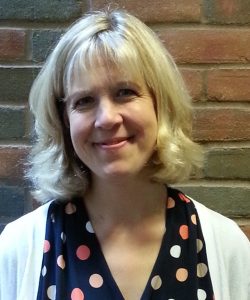
If you want to get a sense of the “electronic evolution” at Augsburg since computers wormed their way into our lives, you would be well advised to ask Kathy Kuross ’85, Senior Programmer/Analyst for IT (Information Technology). She has quite an Auggie history!
When she began her employment in º¬Ð߲ÝÊÓƵ in 1986, it was the beginning of a relationship with printers, computers, and IT machinery that has continued for over 33 years. Since those early days, when she did word processing for º¬Ð߲ÝÊÓƵ–followed by work in institutional research, programming, and analysis–she has had a front-row seat from which to observe—and experience—this electronic evolution at Augsburg.
When Arthur Met Bev
And how did Kathy’s 33-year commitment to Augsburg evolve? Kuross has said that she “owes her existence to Augsburg” since her parents met on campus. Her father, Arthur Kuross, arrived at Augsburg as a first-generation college student in the early ‘50s, after having served in World War II. On campus, a certain young secretary in the Teacher Placement Office caught his eye—Beverly Eckman. Before long, he asked her for a date, and she sought advice from Millie Nelson, then the switchboard operator. Millie (who subsequently served Augsburg for decades, most notably as College Center manager) thought the date was a good idea, granted her approval, and the following year, she was present at their wedding.
Arthur, who had emigrated from Norway as a small boy, stayed connected to Augsburg as the years unfolded, particularly through sports. Several of his college buddies would join him at football and hockey games, and Kathy relished the invitations to join her father and his friends at many of the games. Arthur became very active in the A-Club and served as its president for a number of years.
Still Connected
Kuross in her early work setting in the Science building
When Kathy accepted a position as word processor in the º¬Ð߲ÝÊÓƵ office in 1986, just months after having completed her Bachelor of Arts degree, she worked in the Science building—the same building in which her mother had worked 36 years earlier. Certainly, there had been changes in how office work got done over those 36 years, but those changes would likely pale by comparison with those that Kathy has observed in the 33 years since then.
Kathy began her work when there was only one printer on campus and most people were still using typewriters. At that time, she would carry all the students’ admissions folders in a metal bin from the º¬Ð߲ÝÊÓƵ office (then located in a house) to the basement of the Science building, where the Administrative Computing office was located.
She recalls the Registrar’s office using punch cards to process registrations and pasting labels for each term’s data onto students’ transcripts. Eventually, the campus moved on to using a mainframe computer system, with green-screen computer terminals at people’s desks. Larger reports were printed on a giant green bar printer. (Remember the wide perforated continuous-feed green-and-white sheets with holes along both margins?)
As Kuross reflects on the many changes in electronics and campus life, she notes that in 1985, the top five names of students attending Augsburg were Johnson, Anderson, Peterson, Olson, and Nelson. Today, the top five names are Vang, Johnson, Yang, Lee, and Mohamed. Kuross is proud to work at a university that has expanded its reach and willingly changes, adapts, and grows.
When she started at Augsburg, there was a room in the Christensen Center that played MTV videos all day. The name of the cafeteria was the Chin Wag, and it was located at the base of the current stairway in Christensen Center. Employees could smoke at their desks. Parking was free. At registration time, students waited in long lines in the gym.
By contrast, Kuross can now sit at her IT desk and watch thousands of registrations happen in minutes. We now have lactation rooms, foot-washing stations, and gender-neutral restrooms. Whereas faculty advisors once did all the advising, we now have the Gage Center, with a whole floor of the library designated to assist students. There is an Academic Advising office, TRIO, CLASS, StepUP, and Multi-cultural Student Services, just to name a few.
Throughout her 14-year stint in IT, plus 13 years of institutional research and earlier admissions work, Kuross has not been lured to other workplaces. When asked why, she responded that she values the quality work environment, the friendships, and the challenges, both personal and professional.
She has found particular fulfillment through her role in helping Augsburg students graduate. Over 33 years, that’s a lot of students!
The full and melodic harmony reminiscent of male quartets that represented many Lutheran colleges in the first half of the 20th century will be on full display at the Silver Auggies lunch on Saturday, September 28, when the Augsburg Male Quartet from 1959 provides special music.
The luncheon music will feature Rennard Svanoe ’59, MDiv ’62; Victor Svanoe ’62; Jim Svanoe; and Donald Gilberg ‘60. Intended for Augsburg graduates from 1968 and earlier, the luncheon is one of and Reunion Week, Sept. 24-28.
In the late 1800s, Augsburg was among the first Lutheran colleges to discover the value of these “singing ambassadors,” whose four-part a cappella harmony and spiritual messages inspired many in congregations, youth conventions, and a variety of other venues. Augsburg’s history of male quartets (1885-1961) has been documented in the 2004 book, The Augsburg Quartets: A Mission-Driven Tradition, written by David M. Larson and Merton Strommen ’42. The book includes pictures of most of the Augsburg quartets, whose early participants included F. Melius Christiansen, whose distinctive mark on Lutheran a cappella choir music is indelible.
Of the three Svanoe brothers who sang with Gilberg in the 1958 quartet—Alfred, Rennard, and Victor, two will sing at the luncheon. Alfred has passed away, and his cousin, Jim Svanoe, a Luther College graduate, will fill his role on Sept. 28. Joe Nystuen MDiv ’62, who sang with the 1959 (touring) quartet, is living with one lung, and so Gilberg will take his part.
Starting Early
Growing up in a “singing family,” the three Svanoe brothers got a good head start in the art of harmonizing by performing at family gatherings, where they would sing three-part treble harmony—before their voices changed. In their high school years, their uncle Dick Svanoe sat at the piano and added his barbershop-trained voice, thus providing the fourth part.
At college, singing in the Augsburg Choir put the Svanoe brothers in touch with Don Gilberg (from Carpio, North Dakota)—a connection that led to formation of the quartet, and eventually to an audition with Augsburg’s Leland B. Sateren in order to enable them to officially represent the College as the Augsburg Male Quartet.
Often, the quartet sang at the Svanoes’ home church, Oak Grove Lutheran in nearby Richfield, Minnesota, where Merton Strommen (a member of an earlier Augsburg quartet) had served as the brothers’ high school Sunday School teacher, and as youth choir director. The relationship with Strommen led to the quartet’s opportunity in summer 1958 to sing in Green Lake, Wisc., at the convention of the Luther League Federation, for which Strommen served as director.
A year later, after worship one Sunday, the quartet gathered in the sanctuary where another Oak Grove member, Norman Kaupang, set up his equipment to record the quartet’s songs for a 33-RPM record, which was later remastered for the CD that now appears if you Google “Augsburg Male Quartet.” By then, Joe Nystuen had replaced Gilberg in the group, adding an inspirational verbal component between musical sets at each concert.
Touring
Of his experience touring with the quartet, Rennard Svanoe says his Midwestern horizons were “considerably broadened.” Their travels allowed the quartet to meet nearly all the pastors of the Lutheran Free Church (a predecessor body of the ELCA), and to explore a variety of really interesting places—the Rocky Mountains, Puget Sound, the Columbia River, Norwegian fjords, and the English Channel. Their experiences even included a visit to Svanoe Island, the brothers’ ancestral home on the west coast of Norway.
The quartet appeared at homecoming events at Augsburg (even after graduating), and at various congregations in the Twin Cities area. At one concert, traveling Lutheran evangelist Oscar Hanson heard the quartet sing and was so impressed that he offered to arrange for a tour of Norway in 1961. Hanson (late father of ELCA Presiding Bishop Emeritus Mark Hanson) had served as pastor of a church in Oslo, Norway, and had enough connections to set up a tour that included 55 appearances in the U.S., followed by 25 appearances in Norway.
Most of the group’s concerts in Norway were held in state Lutheran churches, and three in cathedrals. They found their largest crowd in a hall in Bergen, where they filled the facility. That concert holds a special memory for Rennard Svanoe as he recalls one young man climbing onto an open window sill seeking a better view of the quartet, only to land on the ground outside—unharmed, thankfully.
In the Long Term
One notable offshoot of the quartets’ success over the years has been the coming together, since 1993, of numerous former quartet members, to unite in song by participating in the Augsburg Centennial Singers, an all-male choir organized by Strommen, and for some years, directed by him. The group of about 50 continues to perform, and membership has been expanded beyond the former quartets.
Such opportunities can build memories for a lifetime—not to mention long-term friendships. Musical groups tend to have powerful potential to do so. Rennard Svanoe says that singing in the quartet with brothers and a best friend “built in a long-term effect, as we often referred to our experiences over the years.”
When asked if any particular quartet experience stands out as something to truly relish, Rennard Svanoe described a Sunday afternoon concert in Abercrombie, North Dakota, in 1959. As an electrical storm brewed during the first set, the quartet was singing the classical number, “Creation.” As they sang about darkness covering the face of the deep, the lights in the sanctuary went out. Nonetheless, they continued singing—memorization does pay off! The piece continued with words about the Spirit moving over the face of the waters in a prolonged passage that ended with the quartet singing in unison, “And God said, ‘Let there be light,’ and there was light, light, and there was LIGHT.” At that moment the lights came back on in perfect timing with the song.
As the saying goes, God has a sense of humor—and certainly delights in music. The sense of timing on that blessing was absolutely perfect to the Quartet.
Tyler Heaps at training in the UK prior to the opening of the World Cup competition in France.
Tyler Heaps ’13 has loved soccer since he was a boy, kicking a ball around the back yard with his older brother and three sisters. The memories don’t get much better, however, than those made this summer, when his professional work in data analysis allowed him to be embedded with the U.S. Women’s National Soccer Team as it competed for the World Cup in Lyon, France.
On July 7, all the hard work paid off when the U.S. team triumphed over the Netherlands, 2-0, winning its second consecutive World Cup championship. Heaps says playing a tiny part in helping the U.S. win the seven-game series—and the World Cup—was “one of the most challenging and rewarding experiences” of his life—and something he will never forget.
Not unlike football and baseball teams’ use of video coverage and data analysis to enhance skills on the field, coaches and staff at U.S. Soccer are discovering the value of reviewing their own team’s playing habits, as well as those of their opponents, through data collection, video, and studying trend lines. As Heaps says, “No one can recall every action that happened during a game (and especially not 10-15 games), so being able to apply objective data to identify key areas can help in preparation.”
Heaps, who played soccer as an Augsburg student, is now manager of analytics and research for U.S. Soccer, where he oversees the initiatives of the organization to both analyze sports data and help staff scout potential talent. While he loves the excitement of the uncertainty, flow, and freedom of soccer, Heaps feels that the development of new technology—iPads on the bench, data availability, VAR (video assistant referee), etc.—makes for greater precision, helps referees make the correct decisions, and ultimately improves the game.
Heaps with Coach Jill Ellis and the World Cup trophy.
Jill Ellis, head coach of the U.S. Women’s National Team, is one of the soccer coaches who has developed an appetite for this information and has worked to apply it and learn more from it. Ellis, who just announced her retirement from U.S. Soccer on July 30, is only the second coach (first female) to have led a soccer team to two consecutive World Cup championships (Pozzo—Italy, 1934, 1938).
Heaps feels very fortunate to have this opportunity to explore the sports analytics world, especially after having spent most of his time at Augsburg either on the soccer field or behind a computer or math book.
Prior to taking on his responsibilities with U.S. Soccer in 2016, Heaps worked in the human resources firm, Ceridian, where he fine-tuned his skills in programming and data management. During his off-hours, he coached soccer teams—an experience that he finds very helpful in creating relationships with the technical staffs at U.S. Soccer.
As with many college athletes, he continues to enjoy friendships forged on the Auggie soccer field—a great benefit that he credits to the leadership of head coach Greg Holker and his staff. He takes particular satisfaction in seeing the game continue to grow here in the U.S. What better way to see it generate excitement in the U.S. than a huge win in France?
A few months ago, when Ross Murray ’00/M.B.A. ’09 received a letter to his office at , he was astonished to discover he was about to be granted an award. He had been selected by Wartburg Theological Seminary to receive the Living Loehe Award, honoring his work on behalf of LGBTQ communities through GLAAD, the Naming Project, and several other LGBTQ programs. Overwhelmed by what he calls a “huge honor,” he traveled to Dubuque to receive the award at Wartburg’s commencement. The award, established in 1973, honors individuals who have given distinguished service to and through the church, and exemplify Christ’s call to be disciples in the context of their own daily lives and professional commitments.
Murray has worked with GLAAD for eight years directing a variety of programs, including religion, global, the U.S. South, and news. Currently senior director of education and training at the GLAAD Media Institute, he works with various aspects of the media world—advocates and activists (helping them to engage the media as a tool for LGBTQ advocacy); the media industry (advising on how to be fair, accurate, and inclusive in their stories); and corporations (helping them to be effective allies to the LGBTQ community). Each workday is different from the previous one, and Murray’s tasks range from reviewing a script, to screening a film, to developing curriculum, to providing one-on-one messaging to highly visible individuals, to leading courses and workshops—to name a few.
Murray teaching in Australia.
In addition to his responsibilities with GLAAD, Murray is the founding director of , a faith-based ministry serving youth of all sexual and gender identities. Similar to a Lutheran Bible camp, the Minnesota-based summer youth camp has attracted over 200 campers from across the country, and continues to provide a safe place for youth to comfortably discuss faith and how they understand themselves in relation to God and the rest of the world. The coffee house talent show is always a highlight, and it gives campers a unique opportunity to express care and support for fellow campers—fully aware of the importance of feeling included. Murray has been part of The Naming Project since it began 15 years ago, and has been gratified to see many young insecure campers grow into outspoken leaders and advocates.
Working and Studying at Augsburg
Prior to his work with GLAAD, Murray worked with the Youth and Family Institute, º¬Ð߲ÝÊÓƵ, and ReconcilingWorks. Throughout these experiences, faith identity and vocation have been central to his work, and he has often found himself returning to a mantra that he heard over and over from Dr. David Anderson in his Augsburg Youth & Family Ministry classes—that “ministry is about personal trusted relationships.” The repetition of that phrase must have worked because the mantra has become increasingly meaningful to Murray in his ministry and advocacy, and he sees it as key to building bridges of tolerance and acceptance.
Murray explains the mantra: “For people to care about you and want good things to happen for you, they need to know you personally and intimately—not a caricature or stereotype or label, but the actual you.” And that means listening to them, sharing your own story, and offering the gift of vulnerability—of being known. Though time-consuming, the bond that can result from this kind of ministry has greater potential to be deeper and more durable than the connections we make on social media or through our fast-information, media-driven connections. And though a “personal trusted relationship” demands much from each person, the bond is harder to break.
At Augsburg, Murray was a Youth & Family Ministry major, and he feels that his experiences there helped him to be the advocate he is today. He is especially grateful to the Religion Department, and in particular to Janelle Bussert, who encouraged him to create a welcome statement for Augsburg’s Campus Ministry program—a statement that resulted in adding the Campus Ministry program to the roster of Reconciling in Christ congregations and ministry settings, which let it be known that people of all sexual orientations and gender identities are welcome to worship and participate. A few years later, Augsburg became the first Reconciling in Christ University.
LGBTQ Advocacy
After earning his B.A. from Augsburg, Murray earned an M.A. in Christian Education from Luther Seminary, as well as an M.B.A. from Augsburg; and in 2016 he was consecrated as a deacon in the ELCA. His synodically authorized Call was to do LGBTQ advocacy through GLAAD—a reality made possible only 10 years ago by the ELCA Churchwide Assembly when it voted to open the ministry to clergy in same-gender relationships and other professional workers living in committed relationships.
In 2017, Murray celebrated his 40th birthday with a party at the Stonewall Inn in New York City. He chose the Stonewall because of its significance as the site where the modern LGBTQ movement is seen to have begun 50 years ago, when members of the gay community rioted and staged a three-day protest to urge the NYPD to maintain peaceful and quiet conduct on the streets. To Murray, the Stonewall protests and the ELCA policy shift are watershed events—and are reminders of what it means to be part of a “living history.” Much has been done, but much remains to be done.
In April 2016, the same month that Murray was consecrated as a deacon at Advent Lutheran Church in New York City, he married Richard Garnett in the same church. Richard is also an Auggie, having received his B.A. in 2007 and his M.B.A. in 2009.
“We participate in the Easter Parade in New York, and the tradition has been to walk 5th Avenue (in front of St. Patrick’s Cathedral) in your best Easter bonnet. I’m usually the assisting minister at the 9 a.m. worship, and then we head over to the Easter Parade. This year, we put heads on the hats,” Murray said.
A native of Littlefork, Minnesota, a small town near the Canadian border, Murray is amused that a boy whose home had no telephone until he was a junior in high school now finds himself living and working in a bustling metropolis like New York City, surrounded by a remarkable mix of people. And he loves it.
Murray recently returned from Thailand, a country he first visited 20 years ago with Augsburg Professor Emeritus Brad Holt, who was leading a J-term class entitled, “Buddhism and Christianity in Thailand: Spirituality and Dialog.” This time around, Murray has been working on sabbatical projects—most notably, a book about The Naming Project. Stay tuned for word of its completion.
Darin Rowles ’04, ’15 (MSW) has worked in the HIV (human immunodeficiency virus) sector since 1995, a time when an HIV diagnosis was a death sentence. He worked very closely with many people whose lives were coming to an end due to HIV. But in 1995, the first advanced HIV treatment became available—“a game changer in HIV,” says Rowles. Things have changed dramatically since then, and he now has a new opportunity to spread the hopefulness.
On Halloween 2018, Rowles stepped into a new position that will bring to bear his 23+ years of experience in direct-service and management of HIV—and to a much wider audience. As Manager of HIV Services for the Minnesota Department of Human Services (DHS), Rowles now oversees the administration of numerous services for people living with HIV, but on a statewide basis. The work includes the Ryan White HIV/AIDS Program Part B and the AIDS Drug Assistance Program (ADAP).
Ending the Epidemic
Rowles says we now have the treatment options and knowledge needed to end the HIV epidemic. Though there is still no cure or vaccine, two major assets have recently been added to the HIV toolbox.
The first is a concept known as “U=U” (undetectable equals untransmittable), based on research that has shown conclusively that people living with HIV who are able to engage in medical care can maintain an undetectable HIV viral load, thereby preventing them from passing on the virus to sexual partners.
The second new tool is PrEP (Pre-Exposure Prophylaxis), a daily medication for those not living with HIV who want to remain HIV-negative. Rowles says that now we also know how to provide HIV treatments that enhance quality of life for those already living with the virus and prevent transmission to others.
But Rowles acknowledges that some of the greatest HIV challenges we have today are with young people, who are both less likely to use preventive measures like PrEP, and less likely to have the resources to manage their HIV and maintain an undetectable viral load. He knows that much work remains to be done in the HIV sector to raise awareness. In Minnesota alone, there are about 300 new HIV infections each year. In 2017, about a third of the 284 new cases were individuals under age 30, and about one-fifth were 24 or younger. The majority of those 24 or younger were male-identified, and almost all of these identified sex with another male-identified person as their primary risk.
Rowles’ work is cut out for him, and he is excited about this opportunity to gain experience in administering service to the public sector. His new role will include supervising, mentoring, and teaching emerging social work professionals, as well as overseeing the administration of contracted support services, insurance assistance, medication-access programs, capacity-building programs, and policy initiatives–plus monitoring compliance with federal funding, and activities that engage the community.
Previously, much of Rowles’ work involved relating one-on-one to people living with the disease. From 2002 to 2018, he worked in multiple roles with MAP (the Minnesota AIDS Project, now called JustUs Health). In addition, he has done focused worked with people living with serious and persistent mental health issues in residential settings. For five years, he served on the Minnesota HIV Services Planning Council and was an active part of the community planning process in allocating federal funding for HIV services within Minnesota. Currently, he serves on the Board of Directors for the Professional Association of Social Workers in HIV/AIDS.
Minnesotan, Through and Through
Rowles values his Minnesota roots, and confesses to being a “massive Prince fan.” He feels fortunate to have seen Prince over 100 times, often at late-night parties at his Chanhassen studio. In addition to his love for music, Rowles has “geeky” interests, such as Star Wars, Harry Potter, and the Marvel-verse. These interests recharge him for his day-to-day work, he says, as do his husband and three cats, who live with him in South Minneapolis.
Rowles’ ongoing relationship with Augsburg began with some “post-secondary” classes during his senior year in high school. When he put his academic life on pause partway through his freshman year, he took some time to “experience life,” before returning to complete his Bachelor’s degree, and later, his Master’s in Social Work. He has stayed in touch with various professors and with Auggies from his Master’s cohort and has supervised a number of social work undergrads in internship roles. This trimester he is back on campus as a co-facilitator for an Intergroup Dialogue. He says that both of his social work experiences at Augsburg made a major impression on him, and he continues to be a cheerleader for the university and the social work program.
Perhaps Rowles’ greatest contribution as a Minnesotan is yet to come, as he pursues his new work with DHS. In partnership with the Minnesota Department of Health, DHS is implementing a statewide strategy to end HIV in Minnesota. As Rowles says, “We have the tools to end this epidemic, and now is the time.”
When Michael Rivers graduates from Augsburg this spring, he plans to do some private investigative work for criminal lawyers, and then enroll in law school. His goal of becoming a criminal defense attorney with a private practice would seem like a natural progression, especially since that’s what his father has done since 1998. But his pathway to this decision was a long and painful one—and never a given.
Rivers recalls that growing up in the southwest Minneapolis house once occupied by his great-grandparents, he sensed a strong bond between his parents (both Auggies who went on to earn doctorates), and he enjoyed many childhood pleasures—skiing, baseball, and biking the Minnehaha Parkway weekly to Lake Harriet. Life seemed simple then.
But he remembers a lot of fighting, too. When Rivers was five years old, his parents divorced. In the beginning, that wasn’t very troubling for a five-year-old—it meant two birthday celebrations, two Christmas gatherings, two homes, and several “double events.” But within the year, his mother died and—even though the full impact of having her “gone forever” didn’t really sink in—he managed to continue with sports and many of his other activities, including regular attendance at his dad’s Sunday School class. He also participated in an “amazing grief group” at his elementary school, which helped him talk about death with peers and contributed greatly to healing and an understanding of death.
As Rivers was entering his teens, he was told the truth about how his mother had died. She had not been sick, as he had been led to believe. She had taken her own life—just as his grandfather and uncle had done. This new information—and the intentionality of those deaths—forced him to reconstruct everything on which he felt his life had been based.
Trying to Cope
He began drinking at age 13, becoming intoxicated regularly to calm the chatter in his brain. During his teen years (the “trouble phase”), Rivers quit going to church. He no longer had any interest in academics, and his grades plummeted. He resented and disregarded authority and started lying to his father. Expelled from one high school for possessing a taser, he ended up attending three others. He was arrested four times. He ran away from home four times, once ending up in Omaha where he was arrested for shoplifting and being a runaway, another time in Colorado where the $6,000 he had stolen from his father funded a weeklong drug ride, and twice in Florida. He “went through a lot of friends” and surrounded himself with people who had low expectations of him.
The fire that fueled the animosity he then felt toward the world was his understanding of his mother’s death. He felt betrayed and lied to. He was haunted by the image of his mother in her casket: the lifeless body that once held his life inside of her, and the burn marks on her lips from the gun she used—and the images still inhabit his dreams today.
While in an after-care treatment program, Rivers learned there were school programs that could help him earn a GED—a fact that became enticing only when he discovered he could possibly get into Augsburg as well. Though his high school academic record held little promise, his optimism increased as he recalled nostalgically the stories from his parents about how much they had enjoyed Augsburg. He also learned more about the StepUP program, Augsburg’s residential collegiate recovery community.
When Rivers began his studies at Augsburg, he lived in the dorms. He ended his first year with a 2.1 GPA, a slight improvement from high school. But he knew he could do much better. In terms of the required sobriety in StepUP, he had relapsed the first time and had to join the program again. But soon he began to thrive and discovered that there was great value for him in the communal connection he found in the StepUP community, even with substantial staff turnover in the program and some gossiping that can come from living in close proximity.
The Road Ahead
Throughout his Augsburg years, he has gone through waves of emotions, thinking about his mother and the strong possibility that he has likely sat in the same classrooms as she did, interacting with some of the same professors (like Dr. Nancy Steblay, the psychology professor for whom his mother once wrote a meta-analysis).
And he has changed. His outlook on his mother’s death has gone from intense grief and resentment of her and the world to a fuller understanding and admiration of the person she was, and a respect for the world around him. Now, as he approaches graduation time, Rivers can taste victory. Of the last 15 classes he has taken, he has earned a 4.0 in 13 of them, putting him on the Dean’s List for four consecutive semesters and likely resulting in a 3.5 GPA when he graduates.
In the years ahead, Rivers sees himself working on hard criminal cases, owning property, working at both passive incomes and vacation destinations, and traveling the world with the one he loves. Given his skills in photography, he may even start a film production company. But as he pursues law school and a career, his work in Augsburg’s student government will likely be useful, as will advice and encouragement from his lawyer father, Bruce ’91, who is especially pleased about his son’s progress. Bruce says, “It is only through hard work and perseverance that this fine young man has achieved all that he has.” He must be especially gratified that Michael has chosen to pursue the same career path as he did.

 If the temps dip too low, having winter fun in Minnesota can often be a matter of trying to make lemonade out of lemons! Learning how to do that can be tricky. So in the late 70s, Augsburg offered a self-directed interim class, authorized by then-dean Charles Anderson, to beat the winter blues. Entitled “Recreation and Conditioning for Minnesota Winter,” the class included working out in Si Melby, then going outside for winter sports—cross-country and downhill skiing, skating, snowshoeing, and even ice fishing.
 Just in time for Valentine’s Day, join the Augsburg Associates for a “Sweetheart of a Sale” on February 11th and 12th from 10 a.m. to 3 p.m. in the Christensen Center. With vintage jewelry, Valentine-themed gifts, and more it will be a great opportunity to pick out unique and special treats for Valentine’s Day! Love is in the air… see you there!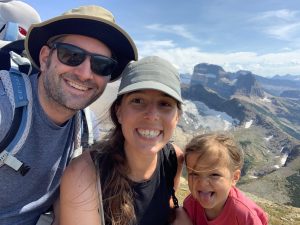
 Prior to her work at Gillette, Bahr served her residency at the University of Minnesota Medical Center, in the Internal Medicine-Pediatrics Program, where she took over as Chief Resident in 2018. Her former co-residents there are among her closest friends, confidants, and cheerleaders, and she sees the MedPeds faculty as having been amazing role models and mentors to her, even showing multiple ways to integrate one’s professional life and personal life.
 Augsburg alumna Maureen (Conroy) Kurtz ’80 cultivated her l¾±´ڱð’s calling at Augsburg through the intersection of English and theater.
 But Maureen hasn’t only worked her magic behind the scenes; she’s also spent a lot of time on the stage, going by the name Rina Kurtz. A highlight of her career was in 2014 when she had the opportunity to go to Hollywood and walk on the red carpet for the premiere of Matthew 18, in which she portrayed Miss Hillshire. She also acted in Thunderbird and The Coffee Shop Wars, along with a handful of short films and many plays.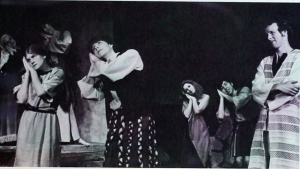
 But this has not stifled her creative mind. Earlier this year, Maureen won a “Most Inspirational” award for her poem about ALS in a walk her sister completed in her honor in Missouri. She is also currently producing a movie, Christmas Slasher.
 Kathy Kuross and the IT Evolution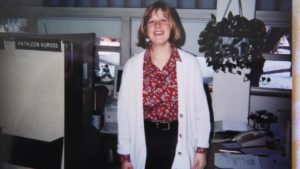

 At college, singing in the Augsburg Choir put the Svanoe brothers in touch with Don Gilberg (from Carpio, North Dakota)—a connection that led to formation of the quartet, and eventually to an audition with Augsburg’s Leland B. Sateren in order to enable them to officially represent the College as the Augsburg Male Quartet.


